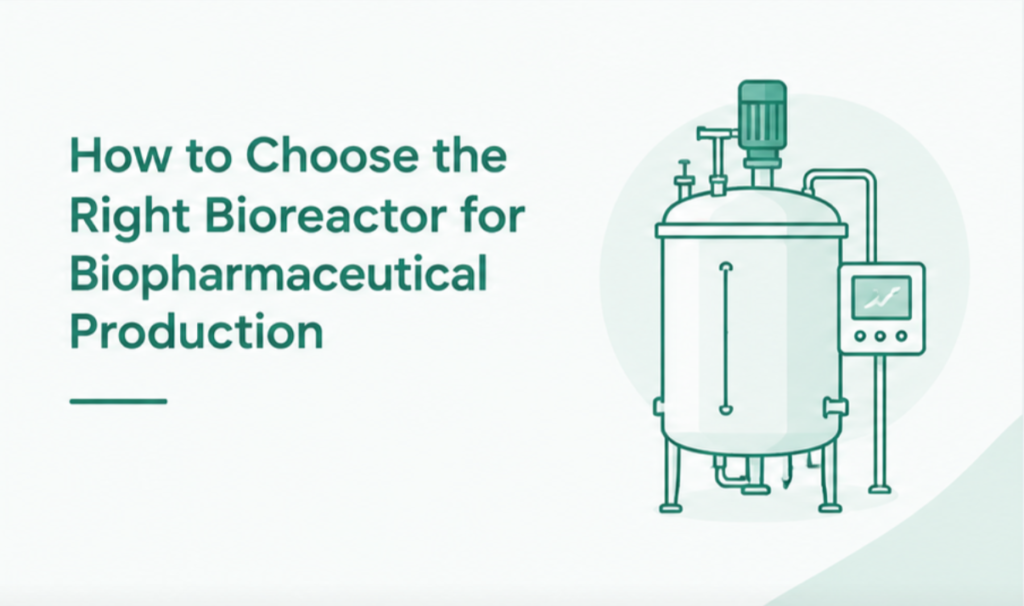
Choosing the right bioreactor is one of the most important decisions in the development and manufacturing of biopharmaceutical products. The bioreactor provides the controlled environment required for cells or microorganisms to grow and produce the desired biological product. Its design and operating capabilities can directly influence process performance, product quality, scalability, and manufacturing efficiency.
The selection process should begin with a clear understanding of the biological system being used. Different cell types and production platforms can have different requirements for temperature, pH, dissolved oxygen, agitation, nutrient supply, and gas transfer. Mammalian cell cultures, microbial systems, and other biological production platforms may therefore require different bioreactor configurations and control strategies.
Production scale is another important consideration. A bioreactor suitable for laboratory-scale process development may not be appropriate for pilot or commercial manufacturing. As production volume increases, parameters such as mixing, oxygen transfer, heat transfer, and process control can become more challenging. Selecting equipment with appropriate scalability can help support a smoother transition from development to larger-scale manufacturing.
Manufacturers should also consider the specific characteristics of the production process. Factors such as culture duration, feeding strategy, operating volume, shear sensitivity, and required process monitoring can influence the choice of bioreactor. The availability of integrated sensors and automated control systems may also be important for processes that require close monitoring of critical parameters.
Single-use bioreactors have become an important option in modern biopharmaceutical manufacturing. These systems use disposable process-contact components and can reduce the need for cleaning and sterilization between batches. They may also provide greater flexibility for multiproduct facilities, development activities, and processes where rapid changeover is important.
Stainless-steel bioreactors remain widely used, particularly in established and large-scale manufacturing operations. Their reusable design can support long-term production and high-volume processes, although they generally require cleaning, sterilization, and associated infrastructure. The choice between single-use and stainless-steel technology should therefore be based on the complete manufacturing strategy rather than on a single factor.
Process control and automation should also be considered when selecting a bioreactor. Modern systems can incorporate monitoring and control of parameters such as pH, dissolved oxygen, temperature, agitation, pressure, and feeding. Appropriate control capabilities can improve process consistency and provide manufacturers with better visibility into production conditions.
Facility requirements are closely connected to bioreactor selection. Equipment dimensions, utility requirements, installation conditions, material flow, process connections, and supporting systems can all influence facility design. For this reason, bioreactor selection should ideally take place as part of an integrated equipment and facility planning process rather than as an isolated purchasing decision.
At Life Square, we support pharmaceutical and biotechnology companies in evaluating biopharmaceutical production equipment according to their process requirements, production scale, and facility objectives. By considering factors such as bioreactor technology, scalability, process control, facility requirements, and future expansion, we help manufacturers identify equipment solutions that are aligned with their production strategy.
Discussion